
Category: Articles
10 Best HR Software for Small Businesses in 2025
TABLE OF CONTENT :
Small business owners spend over a full day every week managing HR tasks. That’s a lot of time! That’s why using HR software is like having your own expert assistant.
With the right HR software, you can speed up up to 80% of your daily HR work, reduce payroll errors, and keep your team more engaged.
In this guide, we’ll help you pick the best HR software for small businesses so that you can handle your daily HR work more efficiently.
What is HR software for small and medium businesses?
HR software for small and medium businesses (SMBs) is a digital solution that lets SMBs handle their human resources tasks in a more efficient way. The applications automate and streamline day-to-day human resource activities, including: managing personnel information, payroll, benefits, leave and attendance, performance and training management, and recruitment.
HR software is particularly important for SMBs because it saves time and effort required in manual paperwork, also improves accuracy, and helps everything remain organized at all times in one place. This allows business owners and HR teams to focus on expanding their business, taking care of their employees, and not spending too much time on paperwork.
In short, HR software for small businesses is essentially an intelligent assistant that manages the back-end of day-to-day HR work and allows for a smoother, less hairy process of managing people.
10 Best HR Software for Small Businesses
- TechForing Human
- Mitratech Trakstar
- RemoFirst
- Bambee
- HiBob
- Oyster HR
- Personio
- TalentHR
- TriNet
- Zoho People
1. TechForing Human
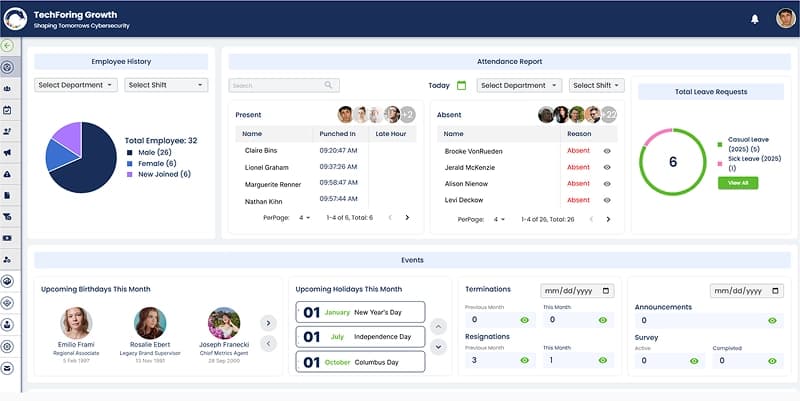
TechForing Human is an easy-to-use employment management software made to help small businesses handle their daily HR tasks without stress. It lets you manage employee details, track attendance, handle leave requests, and measure performance using KPIs, all in one place. You can set goals, reward top workers, and manage promotions smoothly. It also keeps your team updated with a built-in noticeboard and collects feedback easily. The system also takes care of fund management, such as medical, provident, and gratuity, so that you can stay organized and compliant. With everything working together, TechForing Human helps you save time, avoid mistakes, and focus on developing your business.
Key Features
Employee Management: The system centralizes employee data and automates onboarding, training tracking, evaluations, and departmental insights.
Attendance Management: Tracks attendance, schedules shifts, and processes leave requests, reducing errors and easing HR’s workload.
Performance Management: Track KPIs, manage promotions, review performance, and allocate bonuses to motivate employees.
Noticeboard Management: The platform shares announcements and events, collects feedback, and manages separations to keep communication clear.
Fund Management: Calculates Provident Fund, Gratuity, and Medical Fund automatically and integrates with payroll for transparency.
Document Management: HR stores and retrieves contracts, certificates, and expense reports securely, reducing paperwork and ensuring compliance.
Employee Self-Service Portal: Employees update profiles, request leaves, submit expenses, track commissions, and access documents independently.
Reporting & Analytics: The system generates reports on performance, attendance, payroll, and expenses to support informed decisions.
Pros
- Easy-to-use platform that reduces admin work and boosts HR automation
- Compliance support with legal notifications
- Flexible and scalable for businesses of all sizes
Price
- Starter: 20 users, $99/mo
- Basic: 21-50 users, $199/mo
- Premium: 51-100 users, $249/mo
2. Mitratech Trakstar
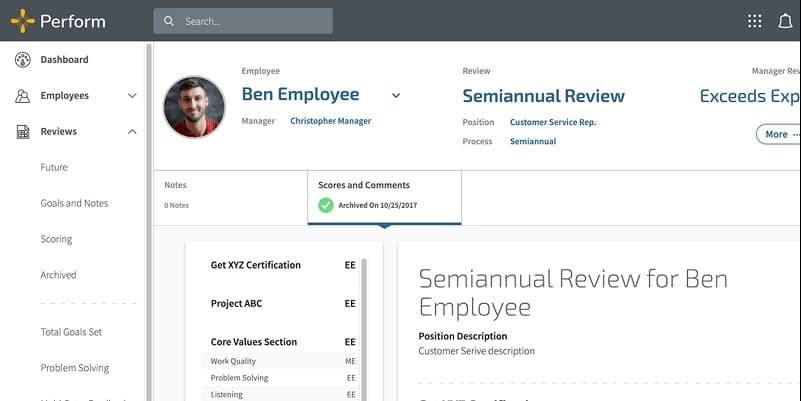
Mitratech Trakstar is one of the best human resource management software programs for small businesses, and it actively helps you manage talent development and performance. You can run performance reviews, set and track goals, gather 360-degree feedback, and align employee objectives with your business strategy- all from a single platform. You can also create and deliver engaging training through its built-in learning management system to continuously upskill your team. Trakstar integrates smoothly with tools like ADP Workforce Now, BambooHR, Paylocity, UKG Pro, Salesforce, Zoom, and DocuSign.
Key Features
Goal Setting: Mitratech Trakstar lets you set and track different types of goals with flexible timeframes. It also includes tools to track OKRs (Objectives and Key Results).
360-Degree Feedback: Mitratech Trakstar collects feedback from coworkers, managers, and team members to give a complete picture of how employees are doing. It keeps feedback anonymous and focuses on helpful advice.
Real-Time Feedback: The platform allows instant recognition and feedback, encouraging ongoing improvement and better engagement.
Learning and Development: Mitratech Trakstar connects learning tools to performance, helping employees improve and prepare for new roles.
Reporting/Analytics: The system creates detailed and easy-to-understand reports to help HR make smart decisions based on data.
Pros
- You can use customizable templates to run regular performance reviews.
- You can easily create and follow employee development plans.
- Helps you spot future leaders by showing clear paths for promotions.
Cons
- It may not work well with some HR systems, causing issues.
- New users might need some time to get used to all the features.
Price
- Free demo available
- Pricing upon request
3. RemoFirst
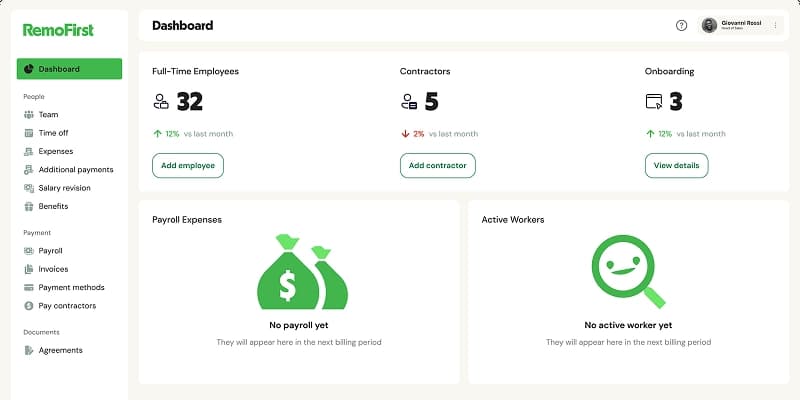
RemoFirst is one of the best HR software for small companies and startups, especially if you're managing a global team. It helps you handle payroll, taxes, and compliance by automating processes and keeping you updated on changing laws. You can track employee salaries, deductions, and contributions across various countries and currencies with detailed reports. It also helps you manage benefits and compensation while keeping all employee data safe in the cloud. RemoFirst connects with tools like Google Workspace, Microsoft Office 365, Slack, and Zoom, and even offers an API for custom setups.
Key Features
Tax Filing and Compliance: Stays updated with tax laws to keep your business following the rules and avoid problems.
Direct Deposit: Sends pay straight to employees’ bank accounts quickly, making them happy.
Employee Self-Service Portal: Let employees update their own information, so HR has less work to do.
Payroll Cost Analysis: Shows you how much you’re spending on payroll to help manage your budget.
Integration with HR Systems: Connects with HR software to keep data accurate and avoid repeating work.
Pros
- Supports multiple countries, ideal for managing international payroll.
- Works well with existing HR systems, reducing manual data entry.
- Each client gets a dedicated support manager for ongoing help.
Cons
- It may not suit businesses with particular payroll needs.
- New users might need time to get familiar with all the features.
Price
- Free demo available
- From $25 - $199/user/month
4. Bambee
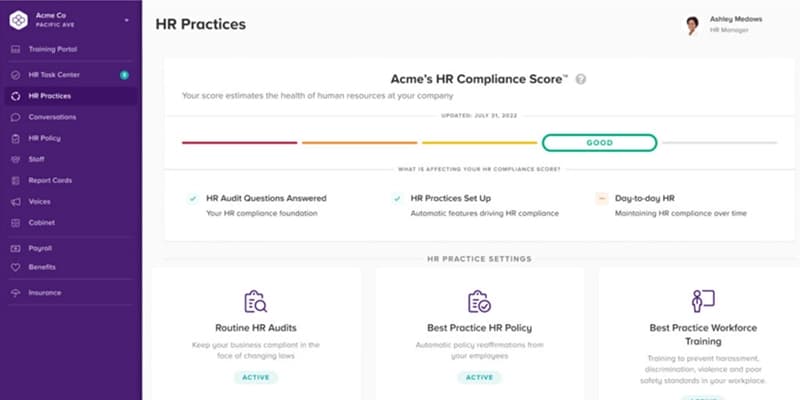
Bambee is a cloud-based software for HR management that helps small businesses handle important HR tasks easily. With Bambee, you get support from certified HR experts who guide you through employee onboarding, creating company policies, handling terminations, and staying compliant with the law. The platform is simple to use, and you get a dedicated HR manager to answer your questions. Bambee also offers an optional payroll service to make paying your employees easier. Bambee lets you focus on running your business while making sure your HR stays organized and follows the rules, all without needing a full-time HR team.
Key Features
Easy Onboarding: Bambee makes it simple to bring new employees on board. The step-by-step process helps you get new hires up and running quickly.
Employee Database: Bambee keeps all your employee records in one place. Bambee organizes your team’s information so you can find what you need fast.
Custom HR Policies: You can create HR policies that fit your business. Bambee helps you stay compliant with the law while keeping your policies relevant and valuable.
HR Compliance Help: Bambee keeps your business updated with changing laws, helps you avoid fines, and stay compliant with employment rules.
Employee Training Programs: Boost your team’s skills with training tracks. These programs improve job performance and help employees grow.
Pros
- Direct advisor access allows personalized HR support.
- Custom policies help meet specific business compliance needs.
- Training support aids employee development and retention.
Cons
- The feature set may be too basic for larger organizations.
- Integration issues could disrupt existing workflows.
Price
- Free demo available
- From $99 - $499/user/month
5. HiBob
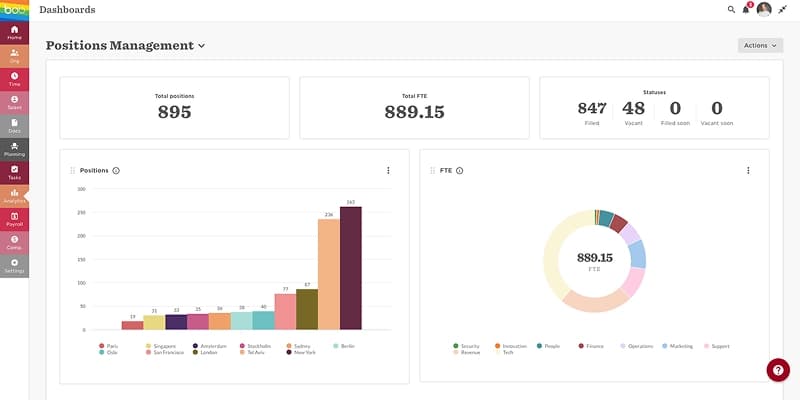
HiBob is a modern human resources software that helps you manage your team efficiently. It brings all HR tasks- hiring, onboarding, performance reviews, and time-off requests- into one simple platform that is easy to use. With HiBob, your employees can update their own information and handle requests without needing constant help. The software also connects smoothly with popular tools like Slack and Microsoft Teams, so everything works together. HiBob connects smoothly with top tools for hiring, payroll, global employment, and learning. These integrations help companies fit HiBob into their current systems without trouble.
Key Features
Onboarding: HiBob automates tasks, tracks progress, and creates personalized welcome flows to help new employees settle in smoothly as the company grows.
Performance Management: HiBob establishes goals, organizes regular feedback, and performs 360 reviews to help with the personal growth and development of the employee.
Time and Attendance: The software tracks work hours, vacation days, and attendance to ensure accurate paychecks.
Compensation Management: HiBob maintains and automates all salary, bonuses, and pay structures in the pursuit of keeping your top employees motivated and happy.
Self-Service: HiBob allows employees to update their details, request time off, and access personal files, reducing HR’s manual work.
Pros
- HiBob has a modern, user-friendly design that simplifies HR tasks for everyone.
- It delivers real-time data and customizable reports for informed decision-making.
- HiBob integrates smoothly with other tools to streamline tech stacks.
Cons
- Payroll integration doesn’t work seamlessly in all regions.
- Smaller teams might find the wide feature set overwhelming.
Price
- Free demo available
- Pricing upon request
6. Oyster HR
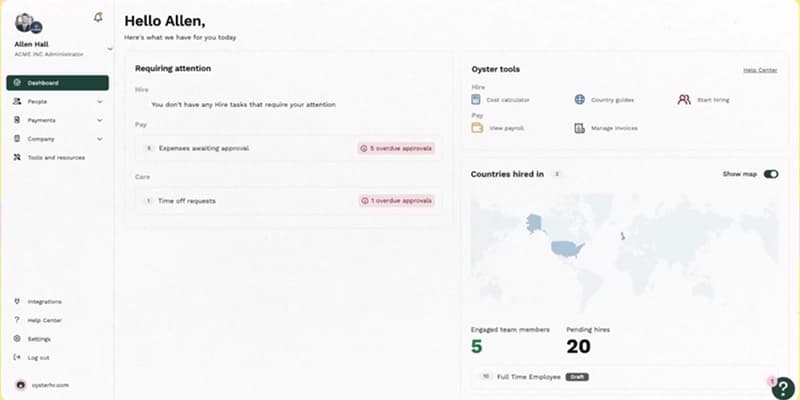
Oyster HR is a cloud-based employee management software that helps you hire and manage people all over the world without needing to set up local offices. It makes onboarding, payroll, benefits, and legal compliance simple, so you can focus on extending your business. With Oyster, you can hire workers in more than 180 countries, pay them in over 120 currencies, and offer benefits that fit each location. The platform takes care of the tricky parts like following local laws and handling payroll automatically, making it easy for you to manage a global team smoothly and confidently.
Key Features
Employee Onboarding: Oyster creates contracts, collects documents, and sets up payroll to help new employees join quickly and smoothly.
Global Payroll: Oyster pays employees on time in their local currency and handles taxes and benefits for every country.
Compliance Management: Oyster updates contracts and makes sure companies follow local laws and tax rules in over 180 countries.
Benefits Administration: Oyster provides health insurance and benefits, manages enrollments, and lets employees easily access and claim them.
HR Support: Oyster’s local HR team answers questions, guides managers, and helps employees understand cultural differences at work.
Pros
- Handles global payroll, including taxes, deductions, and local currency payments.
- Offers customized benefits packages based on the employee’s country.
- Simplifies onboarding with compliant contracts and digital signing.
Cons
- The platform operates separately and doesn’t integrate directly with some popular HR and payroll systems.
- Oyster has employer-of-record services only and does not provide a PEO co-employment model.
Price
- Free demo available
- From $25 - $699/user/month
7. Personio
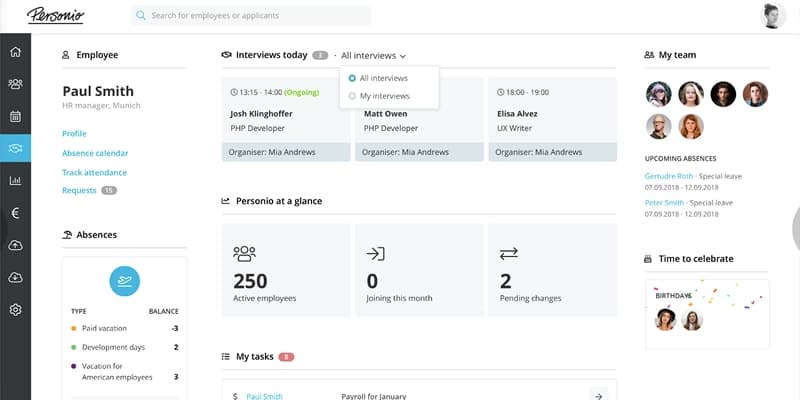
Personio is a human resources software solution that enables you to consolidate all of your HR tasks in one location. It’s an easier way to hire, to manage applicants, to onboard employees, to process payroll, and to track time and attendance. You can also easily track performance, training, and personnel without having to switch between multiple tools. Personio integrates with the apps you already use, such as Microsoft Teams, Slack, and TravelPerk, keeping your workflow smooth. You can save time and make better decisions with some helpful features like automation and clear reports.
Key Features
Applicant Tracking: Personio helps companies post job ads, track applicants, and manage communications efficiently to speed up the hiring process.
Employee Onboarding: Automates onboarding activities and KPI allocation, and enables a smooth and organized introduction for new employees.
Performance and Development: Enables managers to set goals, review employee performance, provide feedback, and create plans for continuous development.
Time and Tracking: Tracks employee work hours, attendance, and leave requests, simplifying timesheets and ensuring payroll compliance for employers.
Absence Management: Personio lets employees request leave and helps managers approve absences while maintaining clear records of team availability.
Pros
- Gives an all-in-one HR platform for recruitment, payroll, and performance.
- Provides an easy-to-use interface that simplifies HR tasks and navigation.
- Integrates with over 200 apps to improve workflow automation.
Cons
- Customer support is sometimes slow and inconsistent.
- Pricing can be expensive for small businesses.
Price
- Free demo available
- Pricing upon request
8. TalentHR
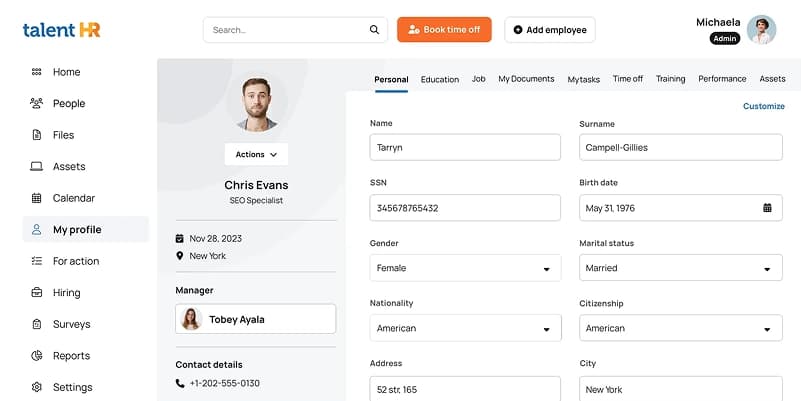
TalentHR is a modern HR management system software that helps small businesses manage their teams easily. It brings all your HR tasks- hiring, onboarding, time-off tracking, and performance reviews- into one simple and intuitive platform. Employees can handle their own information, request time off, and access documents without needing HR’s help. TalentHR integrates smoothly with tools like Slack and TalentLMS, so your team stays connected and efficient. Designed by the creators of TalentLMS, TalentHR makes it easy for businesses to streamline operations and focus on people.
Key Features
Onboarding: TalentHR lets you create custom task lists, assign responsibilities, and deliver training through TalentLMS to give new hires a smooth start.
Performance Management: You can set employee goals, schedule feedback sessions, and run reviews to support ongoing development.
Time Off Tracking: TalentHR lets you define custom leave types, track vacation and sick days, and approve requests with just a few clicks.
People Analytics: This tool provides you with clean reports on headcount, demographics, performance, and salary so you can make smart choices.
Self-Service: Employees can update personal details, submit time-off requests, and download documents without waiting for HR.
Pros
- Has a user-friendly design and offers an affordable price.
- Provides real-time data and flexible reports to help leaders make better decisions.
- You can connect it with Slack and TalentLMS for a more efficient workflow.
Cons
- You’ll need the Premium plan to unlock advanced features
- The wide range of features might take time to learn for very small teams.
Price
- Free demo available
- From $2 - $4/user/month
9. TriNet
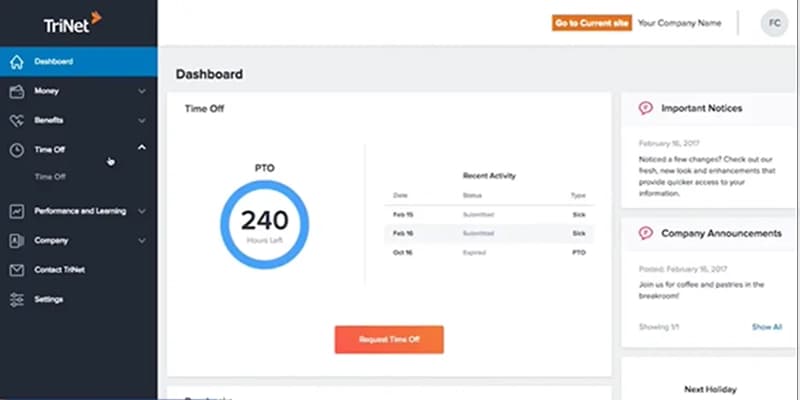
TriNet is an all-in-one human resources management software that helps you manage your team more easily. It handles everything from payroll and benefits to hiring, time tracking, and keeping up with legal rules. You get a user-friendly dashboard where you can see and control all your HR tasks in one place. TriNet also gives you helpful tools like performance reviews, training options, and real-time reports, so you can make smart decisions about your team. It works well with apps like QuickBooks and Slack, making your work even smoother. With TriNet, you save time on admin tasks and focus more on growing your business.
Key Features
Payroll Processing: TriNet automatically calculates and files taxes, processes, and deposits, which are paid directly into employees' bank accounts.
Benefits Administration: The platform manages health insurance, retirement plans, and wellness programs through a centralized dashboard.
Compliance Support: Ensures businesses comply with federal, state, and local laws, such as ACA, COBRA, and HIPAA, through built-in tools and access to HR experts.
Time and Attendance Tracking: The software tracks employee time and schedules, integrating smoothly with payroll and HR systems to simplify attendance management.
Employee Self-Service Portal: Allow employees to easily update their personal information, access pay stubs, and benefits on a secure site.
Workforce Analytics: provides insights into the performance, turnover, and critical data points that would enable growth-focused firms to make better decisions.
Pros
- The tools integrate HR, payroll, and benefits into a single platform.
- The platform scales to fit businesses of various sizes and industries.
- Mobile apps let administrators and employees perform HR tasks anywhere.
Cons
- TriNet charges higher fees compared to some standalone HR solutions
- Users may need time to learn the platform’s broad feature set fully.
Price
- Free demo available (15-minute)
- Pricing upon request
10. Zoho People
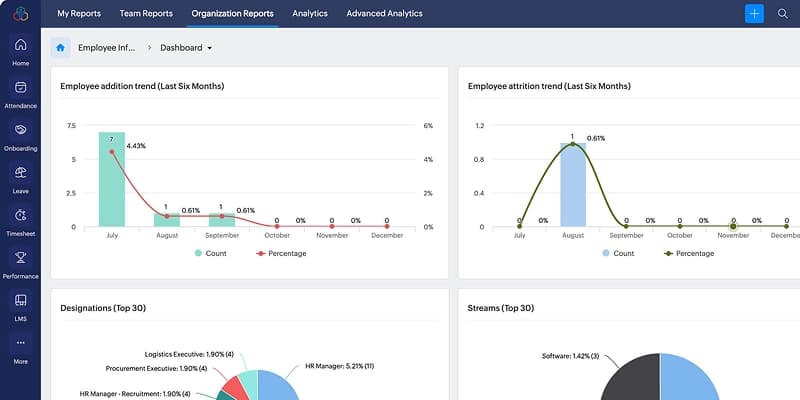
Zoho People is a cloud-based people management software that helps small businesses manage attendance, time off, performance reviews, and employee records easily. You can customize leave types, so your employees can apply online while you track leave by type, location, and role. You can create custom forms with simple drag-and-drop tools, and your employees can update their own records to stay compliant. The software stores and shares important HR documents and uses a live feed to keep your team informed about policy updates. It works well with other Zoho apps and popular tools. Zoho People charges a monthly fee per employee and offers support by phone.
Key Features
Onboarding: Zoho People helps companies manage hiring easily by creating workflows, assigning tasks, and guiding new employees through smooth onboarding.
Shift Management: The system tracks employee attendance using location checks and biometric devices, while helping managers create and manage flexible work shifts.
HR Help Desk: Employees can submit questions or issues, and HR teams respond fast using built-in tools that track and manage requests.
Document Management: Store important files safely, create documents with templates, collect e-signatures, and share files securely within the company.
Performance Management: You can set goals, monitor skills and progress, and run reviews to support employee growth and improve team performance.
Pros
- User-friendly interface that’s easy to navigate
- Convenient mobile app for managing HR tasks on the go
- Affordable pricing suitable for small and medium businesses
Cons
- Limited integrations outside the Zoho product ecosystem
- Occasional performance issues like slow loading during heavy use
Price
- Free demo available
- From $2 - $4.50/user/month
Benefits of HR Software for Small Businesses
Find out how HR software can simplify your daily operations, reduce errors, support your team's growth, and help you stay compliant.
1. Save Time on Repetitive Tasks
HR software automates menial tasks like tracking hours, processing payroll, and requesting time off. Instead of managing a stack of spreadsheets, you can dedicate more time to your business.
2. Avoid Costly Errors
Manual data entry causes errors in salaries, tax declarations, and employee records. HR software does the math and stores data securely, helping you avoid fines and unhappy employees.
3. Stay Legally Compliant
HR platforms stay updated with the latest labor laws and tax rules. They help you keep records, contracts, and reports in line with legal standards, so you don’t miss anything important.
4. Speed Up Hiring and Onboarding
HR software lets you manage job postings, track applications, schedule interviews, and onboard new hires- all in one place. You streamline the process and bring in top talent faster.
5. Keep Everything in One Place
You don’t need to search through emails or folders. HR software stores all employee data- like contracts, reviews, and training records- in one secure and easy-to-access location.
6. Improve Employee Experience
With self-service portals, employees can request time off, view payslips, or update personal info without asking HR. You save time, and they feel more in control.
7. Prepare for Growth
As your team grows, HR software scales with you. You can add features for benefits management, performance tracking, or even global compliance without switching systems.
8. Make Smarter Decisions
HR software gives you real-time reports on employee turnover, attendance, and performance. You can use this data to make informed decisions and plan.
How to Choose the Best HR Software for Small Businesses
Picking the right HR management software for your small business is easier than you think. Here's how you can find the best human resource tools.
Know What You Need
Start by thinking about what your business really needs from HR software. Do you want help mainly with payroll, tracking employee hours, hiring new people, or managing performance reviews?
If you know exactly what tasks you want to simplify, you can avoid paying for features you don’t use. For example, if you just need to track time and pay your team, pick software focused on that instead of something complex.
Set Your Budget
You don’t have to overspend on tools that don’t add value. Check how much the software costs per employee or per month and calculate what that means for your current team size, and any growth you expect.
Some software offers free plans for small teams, which might be perfect if you’re just starting. Others cost more but give you more features and support. Decide what fits your budget and needs.
Choose Software That’s Easy to Use
Make sure the software you pick is simple to use. You and your team should be able to navigate it without frustration. Look for tools with clean dashboards, mobile access, and good customer support or tutorials.
If the software is confusing, you’ll waste time figuring it out, and your team won’t adopt it properly.
Pick Software That Integrates Well
Check if your HR software can connect with the tools you already use - like your accounting software or project management apps. Integration saves you from entering the same data double and cuts down mistakes.
When your HR system integrates well with your payroll or accounting tools, you can get better accuracy and save time every month.
Prioritize Security and Compliance
You hold a lot of sensitive employee data, so security matters. Make sure your software encrypts data, backs it up regularly, and helps you follow local labor and tax laws.
Choosing software that keeps you compliant protects your business from costly fines and builds trust with your employees.
To make your choice easy and effective, check out TechForing Human - a simple, powerful HR software designed for small business owners like you.
FAQs
What are the main types of HR systems?
The three main types of HR systems are HR Information Systems (HRIS), Human Capital Management (HCM) software, and HR Management Systems (HRMS). Each helps businesses manage employee data and HR tasks in different ways.
What’s the difference between an HRIS and an HRMS?
An HRIS stores employee data, allowing employees and HR staff to view and update information and run basic reports. ON the other hand, an HRMS stores a broader range of data and powers extra functions like applicant tracking and performance management.
What are the key features of small business HR software?
Small business HR software should let you centralize employee data, generate reports, manage attendance and leave, plan your workforce, handle payroll and compensation, customize onboarding, share announcements, and integrate with other software you already use.
When should a small business get an HR system?
Startups or small businesses should get HR software as soon as they start hiring over 10 employees or contractors. Using HR software early helps you automate tasks, stay compliant with laws, and build smooth workflows from the beginning.
How do I start an HR plan for my small business?
First, identify your current and future HR needs, like hiring, payroll, attendance, and onboarding. Then, choose HR software that handles these tasks and grows as your business expands.
What is the best HR software for small businesses?
Many startups and small businesses choose options like TechForing Human for their HR needs. The best software for human resource management depends on your company size, the features you want, and your budget.
