
Category: Articles
12 Benefits of a Talent Management System
TABLE OF CONTENT :
The U.S. Bureau of Labor Statistics reports that wages and salaries made up about 70.5% of total compensation costs for private‑industry workers.
Managing such an investment in people requires accurate planning and processes.
Many HR and finance teams still rely on spreadsheets and emails to manage hiring, performance reviews, and budget planning.
These methods sometimes slow down decision-making and lead to mistakes.
In this blog, we will share the 12 main benefits of a Talent Management System and show you how modern TMS helps companies build strong teams.
What Is a Talent Management System?
A Talent Management System (TMS) is an integrated software that combines key HR tasks such as recruiting, onboarding, performance tracking, training, payroll management, and succession planning in one place. HR teams and business leaders get a clear view of the entire employee lifecycle, which decreases repeated administrative work.
Talent management software also provides detailed data that enables companies to spot skill gaps and identify high-potential employees. The system improves collaboration between HR, finance, and leadership and increases employee engagement.
Top 12 Benefits of Talent Management Software
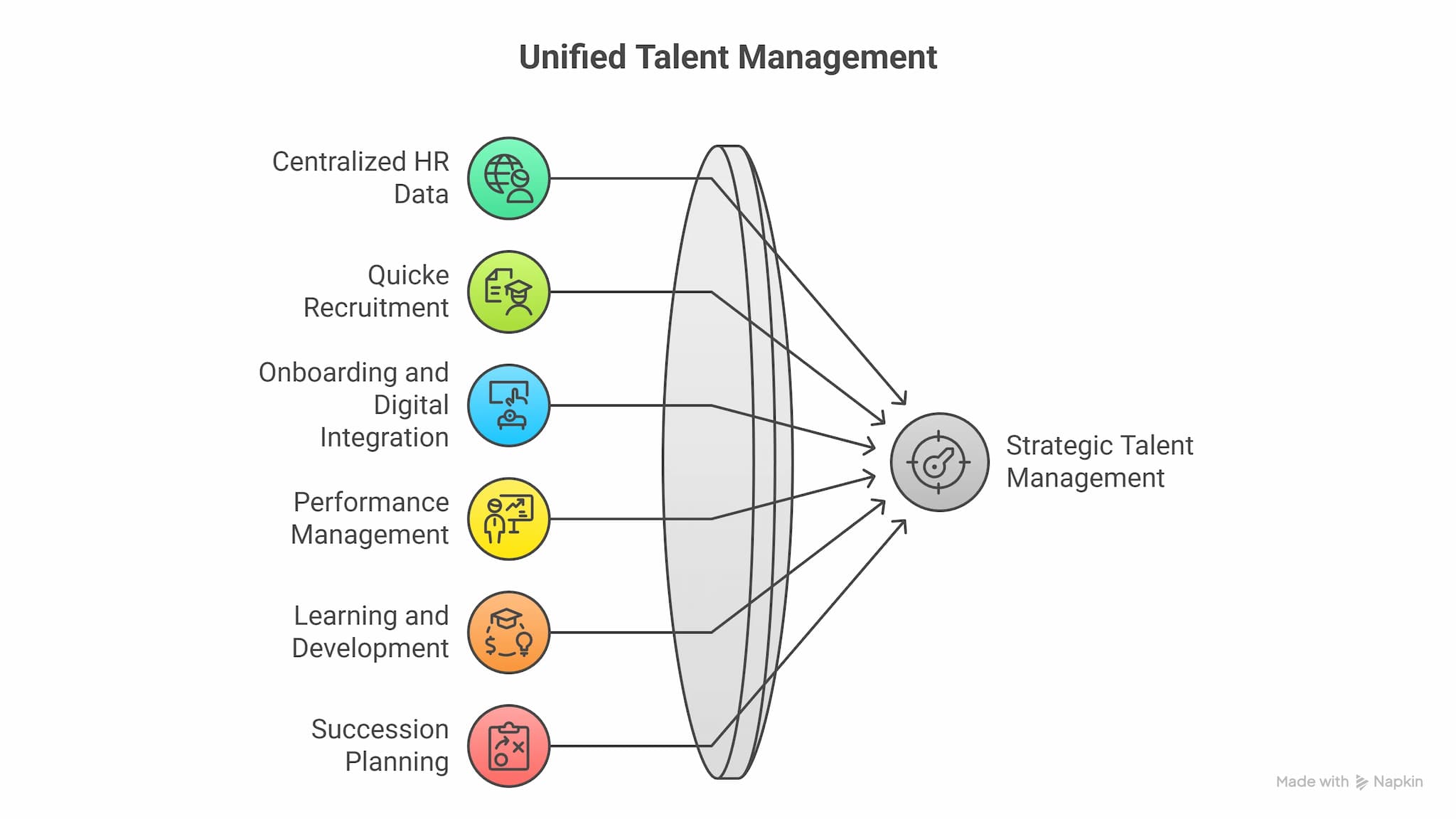
A talent management system helps companies hire top talent, engage them fully, retain them, and prepare them for future leadership.
Here are 12 advantages of a talent management system:
01 # Centralized HR Data
Talent Management Software (TMS) stores all HR data in one place, including recruitment, onboarding, performance reviews, training history, payroll, and attendance.
Every module- hiring, performance, or payroll uses the same database. You can avoid duplicate records, reduce mistakes, and report across departments easily.
HR teams can access real-time dashboards, track employee skills, and maintain proper audit logs. Global companies or those under strict regulations get reliable compliance and accurate reporting.
02 # Quicke Recruitment
Modern HR Talent Management Software comes with an Applicant Tracking System (ATS) that posts jobs across multiple boards, parses resumes, and creates candidate profiles automatically.
You can schedule interviews and send reminders without manual work. Smart filters and keyword matching let you focus on the best candidates. Automation speeds up hiring, improves candidate quality, and frees your team from repetitive tasks.
03 # Onboarding and Digital Integration
When a new employee joins, the onboarding module handles paperwork, policy briefings, training schedules, and system access based on roles.
You can track each step of their progress. On the other side, new hires can complete forms and access resources through secure portals.
Automation keeps processes consistent, reduces manual work, and helps employees get productive very quickly.
04 # Performance Management
Talent Management Software lets you track performance continuously. You can set goals, hold regular check-ins, gather 360-degree feedback, and monitor progress on dashboards.
Both managers and employees can see the same data, which builds transparency and helps you make timely improvements.
05 # Learning and Development
Many HR Talent Management Software come with a built-in Learning Management System (LMS) to assign courses, track progress, and connect skills to roles.
You can see who finished training, when, and how those skills match career paths.
Teams can close skill gaps, plan upskilling programs, and keep a skill inventory ready for upcoming projects or promotions.
06 # Succession Planning
When you get performance, training, skills, and career data in one system, you can build strong talent pipelines and succession plans.
The software highlights high-potential employees, tracks who is ready for promotion, and maps career paths.
You can reduce reliance on external hires, ensure smooth leadership changes, and keep operations running when key team members leave.
07 # Data-Driven Workforce Analytics
A TMS gives you clean data from every HR process, including hiring, performance reviews, learning, pay, and exit trends.
You can track funnel numbers, identify why people leave, and see where skill shortages slow down teams.
Predictive tools forecast hiring demands and warn managers about rising turnover risk. Strong analytics help HR leaders guide the company with real data instead of guesswork.
08 # Fair and Transparent Compensation
A modern TMS gives you one place to link performance scores with salary and reward decisions. You can set clean rules for pay, bonuses, and benefits.
Every team member knows how rewards work because the same criteria apply to everyone.
Your organization feels fairer and open. Managers can review compensation decisions with more confidence and less stress.
09 # Lower Administrative Workload
HR work becomes easier when a TMS manages routine tasks. The platform updates records, handles forms, organizes documents, manages schedules, and tracks progress.
Automated reminders keep workflows on time and reduce the risk of errors.
A unified system supports clean data, smooth audits, and more room for HR teams to focus on bigger goals that move the company forward.
10 # Improved Employee Engagement
Employees and managers can use self-service portals to view profiles, update details, track goals, enroll in training, and check pay or benefits.
Direct access gives employees more control over daily tasks. The setup increases transparency, builds trust, and strengthens overall engagement across the company.
11 # Lower Turnover
A TMS lets you monitor performance, engagement, and learning progress to detect disengagement before it becomes a problem.
HR can offer training, career guidance, and incentives to retain top talent.
Succession planning and fair rewards strengthen loyalty and reduce the costs of replacing employees.
12 # Aligning Talent with Business Goals
With TMS, you can combine all employee data, such as hiring, training, performance, promotions, and compensation.
You can see where your team excels and where you need more skills.
You can forecast hiring needs and develop talent in line with business priorities. HR becomes a key partner in shaping workforce readiness and achieving company goals.
Who Needs an HR Talent Management System?
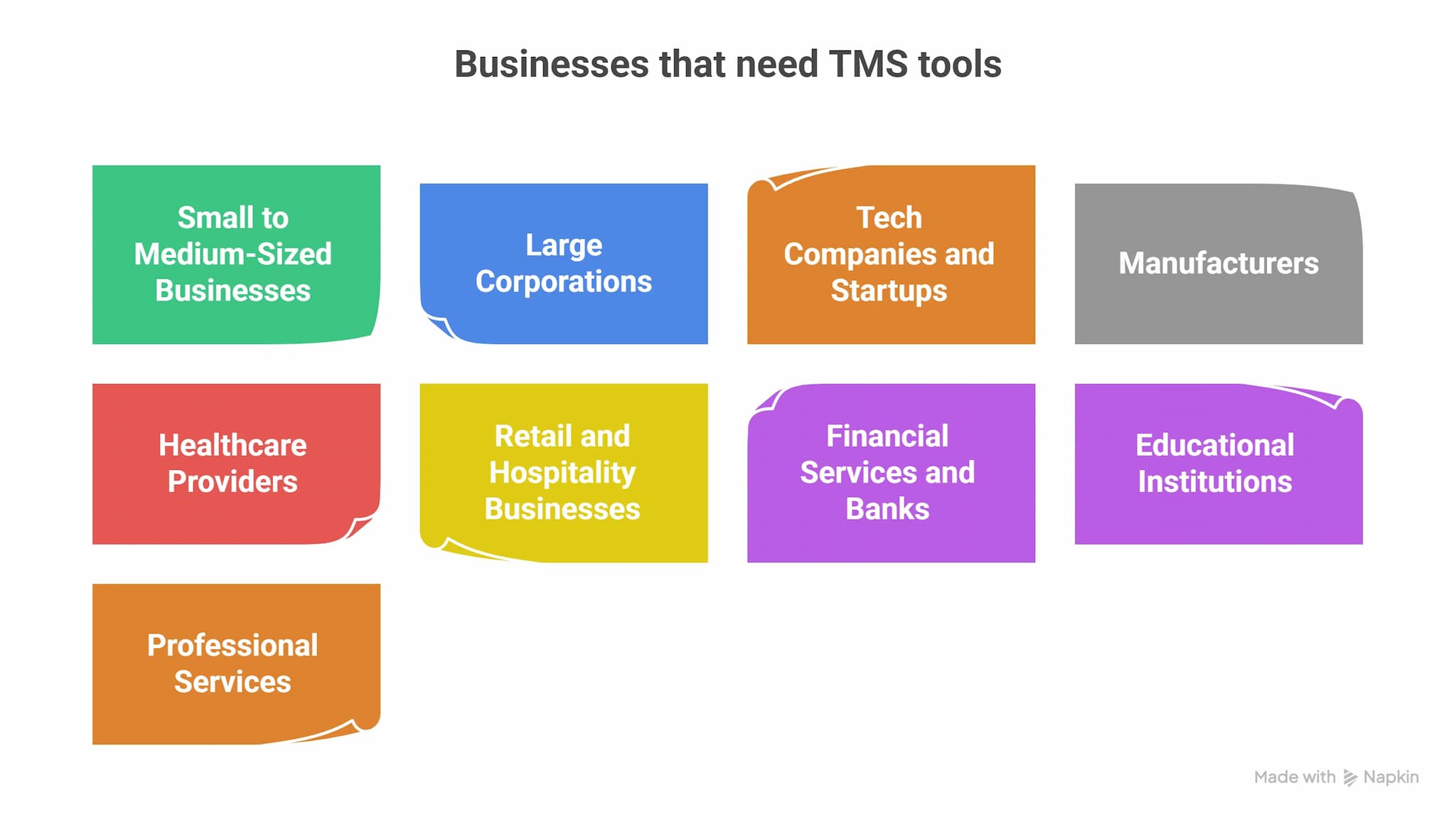
Different businesses face unique challenges, and a TMS helps to address them effectively.
Let's share who needs the tools.
- Small to Medium-Sized Businesses (SMBs) - Grow efficiently with consistent hiring, onboarding, and training processes.
- Large Corporations - Manage complex teams across multiple departments and locations
- Tech Companies and Startups - Track project teams, performance, and skill development in fast-paced, high-growth environments.
- Manufacturers - Monitor safety training, certifications, and compliance across production teams.
- Healthcare Providers - Handle staffing, training, and meet strict industry regulations effectively.
- Retail and Hospitality Businesses - Coordinate seasonal staffing, schedules, training, and performance across locations.
- Financial Services and Banks - Track certifications, regulatory compliance, and performance to meet strict standards.
- Educational Institutions - Manage faculty and staff onboarding, professional development, certifications, and performance reviews.
- Professional Services (Consulting, Law, Accounting) - Track skills, certifications, career development, and billable performance.
- Non-Profit Organizations - Optimize limited HR resources, track staff and volunteer development, and improve retention.
- Government Agencies - Maintain compliance, track training, and manage large, diverse workforces effectively.
- Remote and Distributed Teams - Coordinate global talent, track performance, and maintain engagement across locations.
- Creative and Media Agencies - Manage project-based teams, allocate talent efficiently, and track skill development.
- Any Growth-Focused Company - Onboard employees, track performance, run learning programs, plan succession, and align talent with business goals.
How to Choose the Right Talent Management System
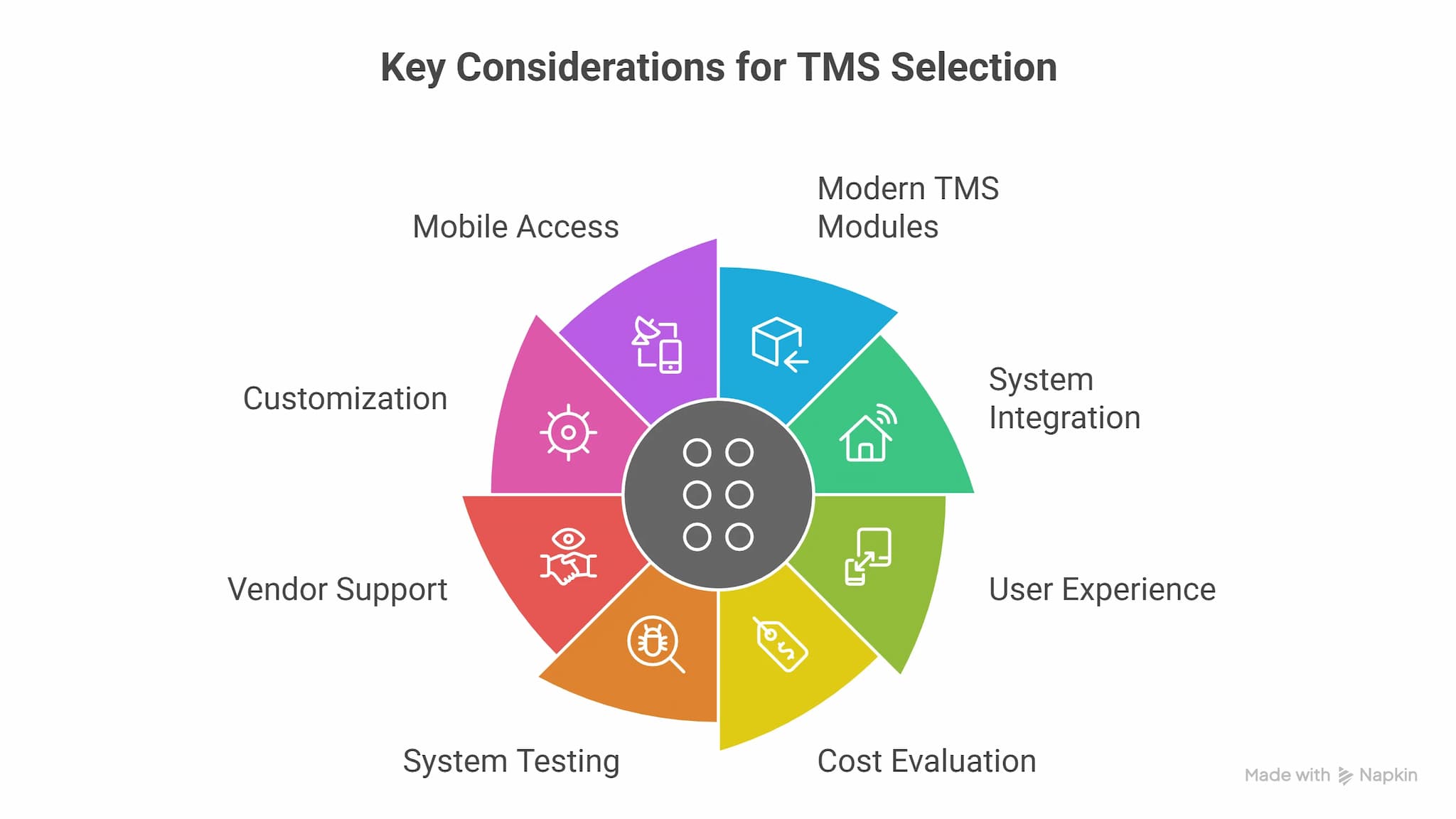
There are a lot of options in the market. Maybe now you are wondering how to pick the right software for your business.
Let’s share.
- Modern TMS includes applicant tracking, performance management, learning management, succession planning, and compensation management. Make sure all the modules integrate smoothly.
- Ensure the system connects with payroll, HRIS, collaboration tools, and ERP software. Strong integration keeps data consistent and allows real-time reporting across departments.
- Choose a system that is intuitive for HR, managers, and employees. Look for role-based dashboards, mobile access, and simple navigation.
- Review subscription fees, implementation costs, training, and long-term support. Consider cloud versus on-premise deployment, licensing models, and potential ROI through faster hiring.
- Test the system with a demo or trial. Evaluate workflows, reporting, usability, and integration.
- Choose a vendor that provides onboarding support, training, and ongoing customer service.
- Look for customizable dashboards, configurable reports, and adaptable processes. A flexible system fits your needs without forcing workflow changes.
- Employees work from multiple locations and remotely. Mobile access allows managers and staff to complete tasks.
Frequently Asked Questions
Is a Talent Management System only for large companies?
No. Small, medium, and large companies all benefit from a TMS.
How do cloud-based TMS platforms compare to on-premise software?
Cloud-based TMS platforms update automatically, cost less upfront, and are easier to scale. On-premise systems offer more control but require higher maintenance and IT support.
What are the 3 C's of talent management?
The 3 C’s are Competence, Commitment, and Culture. They focus on hiring skilled employees, keeping them engaged, and aligning them with company values.
What are the 5 core functions of talent management?
The five core functions are Recruiting, Onboarding, Performance Management, Learning & Development, and Succession Planning.
What are the 4 B's of talent management?
The 4 B’s are Buy, Build, Borrow, and Bind. Companies hire new talent, develop existing employees, use temporary resources, and retain top performers.
How long does it take to implement a Talent Management System?
Implementation usually takes 4–12 weeks, depending on company size, number of modules, and data migration requirements.
Does TMS replace HR teams?
No. A TMS automates routine work, but HR teams still make strategic decisions. The system supports HR, not replaces.
How much does an hr talent management system cost?
Costs vary based on features, users, and deployment. Explore options and get a personalized quote with TechForing Talent to find the best fit for your business.
